SOLUTIONS / AI FOR FINANCE

AI for finance: agents that handle real work inside your tools

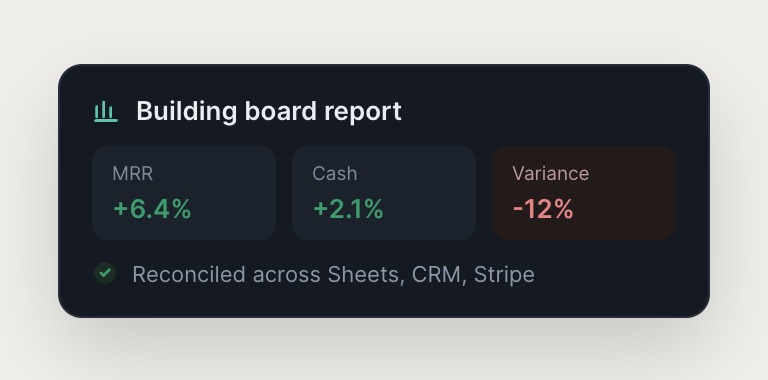
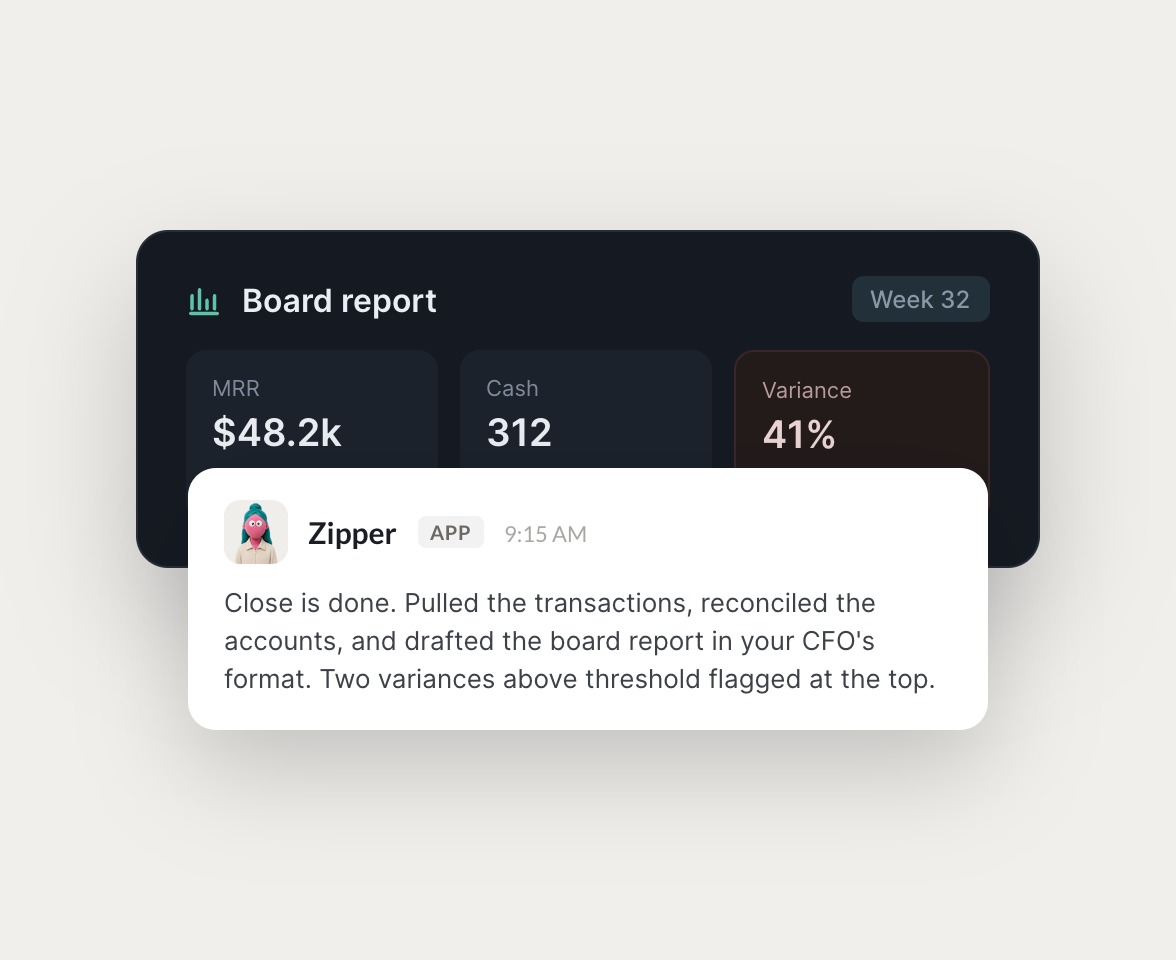
Skydive agents take on real finance work across your stack, right inside the tools you already run on. Your close process becomes a team: one agent pulls transactions, one reconciles, one drafts the board report. They hand off to each other automatically.

Skydive agents at work in Slack

One agent handles one job. Teams handle the whole process.

Finance work often needs handoffs. Each use case is a specialized agent that remembers your GL codes, thresholds, and the format your CFO prefers.

#
finance
Dhruv
The GL is a mess after the migration. Can you reconcile it?
Cove
APP
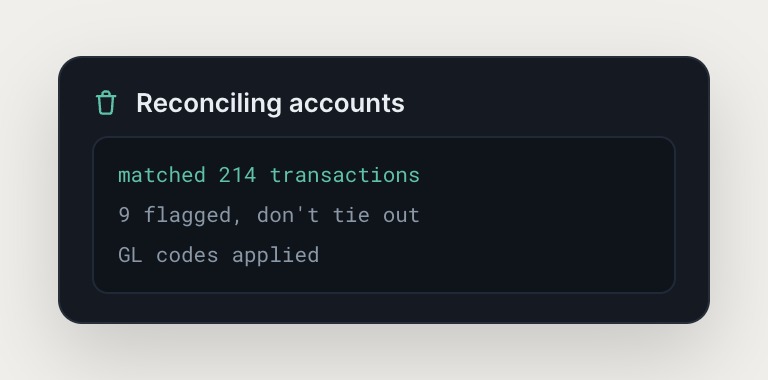
Reconciled the accounts against the GL codes you use, matched 214 transactions, and flagged 9 that don't tie out with the reason for each. Logged every change for your review.
Dhruv
Looks right. Apply it and run this reconciliation every month-end.
#
finance
Dhruv
Did we get any new Stripe disputes this week?
Charcoal
APP
Slate caught 3 disputes and built the evidence packet for each from your records, then submitted them to Stripe before the deadline. Win rate's trending up as it learns what evidence holds.
Dhruv
Perfect, keep handling those automatically and flag only the ones you can't win.
INTEGRATIONS

Works inside your everyday tools.

Each agent has its own computer with a browser, so it logs into your existing tools the way a human operator would, navigating across systems no one has wired an integration for.

and more

Built from a description, not a workflow.

Your finance stack becomes a team of agents that hand off to each other without you wiring the steps.

Agents hand off without you wiring the steps

Your close process involves pulling transactions, reconciling accounts, flagging variances, and drafting the board report. Instead of one agent doing everything, you have a team: one pulls data, one reconciles, one writes. You describe the outcome, and the team figures out who does what.

Each agent has its own scope and history

Your reconciliation agent remembers the GL codes you use and the thresholds you care about. Your reporting agent knows the format your CFO prefers and the metrics that matter. Specialization means better output.

Your data stays yours

Each agent works in its own sandbox and logs into your tools with the credentials you provide. Skydive doesn't store your credentials, and you control which agents access which systems.

We run on Skydive too.

We don't just build Skydive, we run our company on it. Our team puts agents to work every day (they even helped build this page).

"Skydive truly transforms your entire company by automating all of the tedious tasks that consume so much of your day"

Marcus Lowe, Co-Founder
FAQ

Frequently asked questions

How is Skydive different from workflow builders like Zapier or Make?

Workflow builders make you the engineer. You decide the how and construct every step. Skydive builds the agent from your description of the outcome. No canvas to construct, no logic to wire, no prompt engineering. Pre-built templates are productive on day one.

How is Skydive different from single-agent tools like ChatGPT or Claude?

Single-agent tools give you one assistant in a chat that closes when the tab closes. Skydive ships a team. Work persists, hands off between agents, and keeps running while you sleep. Agents have their own identities, scopes, and histories, and they collaborate automatically.

How long does it take to get started?

Sign up, describe the outcome you need, connect the tools, and start delegating. Most operators have their first agent running in under 10 minutes. Pre-built templates are ready to use.

Do I need engineering resources to set up Skydive?

No. Skydive is built for operators, not engineers. Each agent has its own computer with a browser, so it logs into your existing tools the way a human operator would, and no API integrations are required.

Can I share agents across my team?

Yes. Anyone on the team can create agents. Permissions control view, use, or edit on a per-agent basis. Useful agents spread the way useful things inside companies always spread.

What happens if an agent makes a mistake?

Agents remember context and learn from corrections. The judgment you build into an agent persists, so it gets better over time. You can review agent output before it goes live, or let the agent handle routine work automatically.